Articles (9) · Summaries (9)
Generated issue overview: June 1983 issue of HUT!, the monthly Minnesota Canoe Association newsletter. It contains canoeing and river-trip articles, club and chapter news, program information, a calendar, member notices, advertisements, and association forms.
Generated summaries are descriptions, not original captured text. Page-range text shows complete scan pages and may include neighboring material.
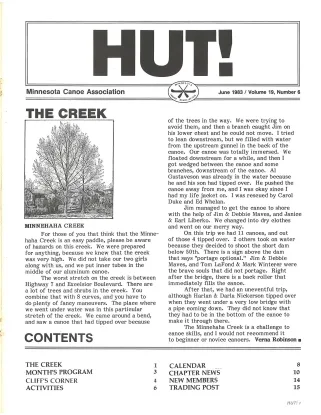
The Creek (Minnehaha Creek)
Title transcribed from original publication
Generated summary: A first-person account of a Minnesota Canoe Association trip on high Minnehaha Creek. The author describes hazards, capsizes, a low dam and bridge, and advises that the creek is not suitable for beginner or novice canoeists.
Open scan page 1
Read captured page 1 →
Cliff’s Corner
Title transcribed from original publication
Generated summary: Reports on a gathering of solo canoeists and compares the canoes participants tried. Jacobson discusses handling, speed, acceleration, stability, and the enjoyment paddlers find in different designs.
Open scan page 4
Read captured page 4 →
Cruisin’ Along
Title transcribed from original publication
Generated summary: Offers practical advice for arranging canoe-trip shuttles and keeping a river-cruise group together for safety. The page also contains separate cruise announcements, which are not included in this article.
Open scan page 5
Read captured page 5 →
Snake River Canoe Race
Title transcribed from original publication
Generated summary: A report on the May 7 Snake River Canoe Race, describing cool and windy conditions, the 18-mile course, shallow rocky rapids, and the event’s organization and results.
Open scan page 10
Read captured page 10 →
The Dukes of Durham Island
Title transcribed from original publication
Generated summary: A humorous serialized canoe-racing tale about the Duke brothers, their canoe General P II, and a race set up by K.N. Haug. The story ends by foreshadowing its continuation in the next issue.
Open scan page 10
Read captured page 10 →
Brule River Trout Scout, 4/25/83
Title transcribed from original publication
Generated summary: A trip report about a group canoe outing on the Brule River. It describes high water, scenic stretches, rapids, a fallen tree requiring a portage, capsizes, and the group’s safe take-out.
Open scan page 10
Read captured pages 10–11 →
Baking Bannock
Title transcribed from original publication
Generated summary: Explains how to bake bannock in a frying pan over a campfire without a reflector oven, including preparation, fire management, turning and browning the bread, and optional additions or toppings.
Open scan page 12
Read captured page 12 →
Welcome to the World of Loons
Title transcribed from original publication
Generated summary: Reviews a North American Loon Fund gifts pamphlet and describes gift items whose sales support loon research and management projects.
Open scan page 13
Read captured page 13 →
Reading a Gauge
Title transcribed from original publication
Generated summary: Briefly explains how to read a water-level gauge, including reading to the nearest tenth at the water line, and gives contacts for additional forms, maps, or gauge lists.
Open scan page 13
Read captured page 13 →