
Membership Drive
Title transcribed from original publication
Generated summary: Reports on the MCA membership drive, its closing date, delayed award accounting, and the importance of continuing to recruit members.
Open scan page 2October 1982 · Volume/issue not printed or unknown
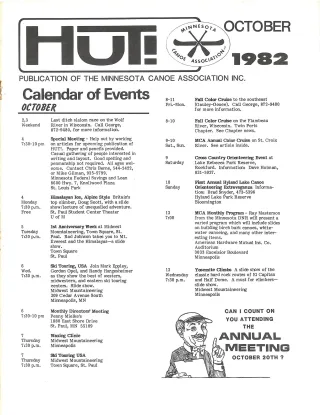
Magazine · 16 pages
October 1982 Magazine
Automatically captured text may contain recognition errors. Compare it with the original scan.
iF I am very happy with the way the canoe paddles. It is a
, very efficient, fun canoe, with sufficient volume for light
: a Co tripping. If you are used to flat bottom canoes, you may
i ie) THY not like it.
If you are interested in this construction technique, give
An Alternative Method of Canoe Construction me a call and profit from my mistakes. Mike Ludvigsen,
884-0033.
by Michael Ludvigsen
Foam is available from:
It is possible to construct a one off canoe using a
composite foam core/fiberglass construction. Some of Wicks Aircraft Supply
the drawbacks to conventional fiberglass construction are Highland, Iinois 62249
the expense of high quality PVC foam and the time and Phone: 618-654-7447
expense involved in making the female mold. It is Clark Foam - 4.5 lb/ft3
possible to get around this by constructing a male mold 24" x 96" x 1/4" sheet @ $10.60/sheet
on a strong back in a manner identical to conventional
woodstrip construction. Information on construction:
When the cross sections are up, take a router and cut Clark Craft Boat Company
grooves every couple of inches and lay 3/8-inch stringers 16 Aqualane
the length of the forms, flush with the edges of the cross Tonawanda, New York 14150
sections. Use a 1/4-inch polyurethane foam that comes Booklet on fiberglass boat construction @ $5
in 2-foot by 8-foot sheets to staple to the forms and
stringers. The foam is thin enough to take slight Local sources of supply:
compound curves, but where there is a large amount of
compound curvature, it is good to work with 1-foot or Mrs. Ketter can get some supplies from Winona
possibly 1/2-foot wood strips. The edges of the foam can and carries West Systems products.
be glued with a construction adhesive if desired.
Polyurethane foams don't have good strength in IASCO
compression, and it is necessary to remove the foam in 5724 West 36th Street
the football area if hitting a lot of rocks is anticipated. Minneapolis, MN 55416 (by Hoigaards)
If the foam collapses, the bottom of the canoe will lose 612-920-7393
its rigidity.
To facilitate removal, coat the area to be removed with a
couple of heavy coats of cornuba wax and a layer of presents
PVA. Foam absorbs a great deal of resin, and it is neces- TOM JOHNSON’S
sary to coat the foam with a mixture of microballons and
resin. One cup microballons to two cups of foam seemed
to work well. When this has hardened, sand it lightly and
lay up the fiberglass on the outside. When the outside is
completed, pop the canoe off of the mold. Pull the
staples out with a pliers from the inside, remove the A revolutionary breakthrough
foam from the football area, and fiberglass the inside. in roto-molded kayak design
Ribs have to be installed, and the seats, thwarts, and
gunnels are installed conventionally. A flatter cross sectional hull
profile reaches the absolute
limits of plastic technology. .
The cost of this method of construction seems to be © greater
about equivalent to the cost of a wooden canoe. The stability
foam costs less than wood, but more fiberglass and resin ° an ee a
are used. Disadvantages are that the foam doesn't have e less drag
very high strength under compression, doesn't have a very coefficient
high shear strength, doesn't have the aesthetic appeal of for faster
wood, and it takes longer to make the mold due to the turns
necessity of installing the stringers. Totally
outfitted with
minicell foam
Advantages are that the foam lays up faster than wood- © low weight:
strips; an all fiberglass bottom will usually take more only 34 Ibs
abuse than a wood/fiberglass bottom; once the mold is © no wear
made, several people could use it with the second canoe er
being started as soon as the first is popped; and flotation and ball
is built into the canoe so that no flotation chambers are © unique sized
necessary. hip brace
system for
This method was used to construct the 15-foot C-1 of al
Karl Ketter's design. The canoe has three layers of 7-1/2 ization
oz. cloth and a total of ten layers in the bottom at the S 479 00
bow and stern. The canoe has gunnels and thwarts cluscshinping Hydra
installed, but no seat or foot braces yet. It weighs 36 lbs. At Hydra P.O. Box 669
and should finish at less than 45 lbs. If more care, skill, Dealers Athens Tennessee
and less materials were used in the construction, it could Nationwide Ps veces, nee
be made lighter.
Generated issue overview: October 1982 issue of HUT!, the Minnesota Canoe Association publication. The issue includes canoeing and outdoor-skills articles, trip reports, association news, event announcements, advertisements, classifieds, and organizational information.
Generated summaries are descriptions, not original captured text. Page-range text shows complete scan pages and may include neighboring material.
Title transcribed from original publication
Generated summary: Reports on the MCA membership drive, its closing date, delayed award accounting, and the importance of continuing to recruit members.
Open scan page 2Title transcribed from original publication
Generated summary: Reviews straight- and bent-shaft canoe paddles made by Bending Branches, describing their construction and inviting readers to try a test paddle.
Open scan page 4Title transcribed from original publication
Generated summary: Explains the Ten Essentials for outdoor trips, presents an expanded 13-item list for day trips, and discusses selected gear and the original essentials list.
Open scan page 5Title transcribed from original publication
Generated summary: Reports on Verlen Kruger and Steve Landick's long-distance paddle journey from Alaska down the Pacific Coast, including mileage and plans for a reception and slide presentation.
Open scan page 5Title transcribed from original publication
Generated summary: Recounts a Twin Ports Chapter outing to the Apostle Islands, with camping, paddling, group activities, and a return trip in difficult weather; it also notes future chapter events.
Open scan page 6Title transcribed from original publication
Generated summary: Describes building a one-off canoe with a foam-core and fiberglass construction method using a male mold, including materials, steps, advantages, drawbacks, and a finished example.
Open scan page 7Title transcribed from original publication
Generated summary: A photo supplement to a cruise report from the previous issue, presenting memories from the Crow Wing River trip through accompanying photographs and an editor's note.
Open scan page 8Title transcribed from original publication
Generated summary: Describes a father-and-son canoe trip on the Big Fork River, including route and outfitter details, rapids, campsites, and river conditions. The supplied OCR cuts off during the account.
Open scan page 8Title transcribed from original publication
Generated summary: Introduces canoe routes, landscapes, access points, campsites, fishing, and visitor resources in Voyageurs National Park, contrasting its character with the Boundary Waters and Quetico.
Open scan page 9Title transcribed from original publication
Generated summary: Recounts an expedition on the remote Hood River in the Northwest Territories, describing challenging whitewater, weather, wildlife, route planning, and Wilberforce Falls.
Open scan page 9Title transcribed from original publication
Generated summary: Describes a Labor Day trip to Rebecca and Curtain Falls, including route choice, portages, campsites, and the scenery at the falls and on the return journey.
Open scan page 11Title transcribed from original publication
Generated summary: Discusses learning and using a canoe pole for upstream travel, river observation, and controlling a canoe in current, with notes on a clinic and the author's experiences.
Open scan page 11Title transcribed from original publication
Generated summary: Offers practical advice on packing meals and cookware for canoe trips, including food containers, organizing meal bags, cleaning bottles, selecting cooking equipment, and packing a cook set.
Open scan page 12Title transcribed from original publication
Generated summary: Announces plans for a Minnesota DNR lease sale involving state lands for copper-nickel exploration and summarizes the areas under consideration and the lease requirements.
Open scan page 13Title transcribed from original publication
Generated summary: Reports the proposed elimination of federal Waterbank funding and relays the Minnesota DNR's case for preserving the program's wetland and wildlife benefits.
Open scan page 13Title transcribed from original publication
Generated summary: Summarizes efforts to establish beverage-container deposits, describing litter and resource arguments, state examples, and opposition to proposed legislation.
Open scan page 14Generated summary: A section listing businesses and services supporting the MCA, with contact details and descriptions of their offerings.
Generated summary: Roster of MCA executive officers and directors with roles, names, contact information, and locations.
Generated summary: Roster of chapter committee contacts for MCA chapters and activity groups.