
TOWBOATS ON MY RIVER
Title transcribed from original publication
Generated summary: A river worker describes towboat size and operation and gives canoeists practical advice for staying safe around towboats, channels, and locks.
Open scan page 3May 1982 · Volume/issue not printed or unknown
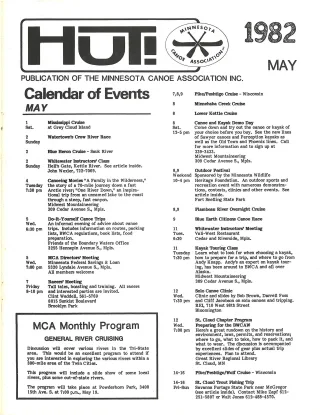
Magazine · 16 pages
May 1982 Magazine
Automatically captured text may contain recognition errors. Compare it with the original scan.
TOWBOATS ON MY RIVER These boats displace so much water that in a narrow spot
the water can't get past the end of the tow fast enough,
by Bob Brown so the water simply builds a wall in front of the tow.
Over twenty years I've been working on the river, and a Once this wall passes, the river will drop you just as
towboat still leaves me in awe. I guess I'm most abruptly. What a perfect way to get floated up over
impressed when I'm out in a 14-ft. solo boat and a some rocks and dropped.
towboat passes me.
The small harbor boats that you meet above the Ford
What exactly is a towboat? Some of you may never have Dam have a problem unique to harbor boats. They can't
seen one up close. They are large work boats that push see where they're going. Really; with empty barges these
barges and move cargo. Their size depends on where you smaller boats often can't see a thing in front of them.
see them. There should be a law against, it but there isn't.
From St. Paul upstream a typical boat is from 600 to These small tows move barges around by looking out the
1200 H.P. and pushes 2-4 barges. Below St. Paul the size Sides to see where they've been. The skippers depend a
jumps to 3000 to 6000 H.P. These St. Paul to St. Louis lot on their deck hands with walkie talkies.
boats often push up to 15 barges. . .
It is fortunate for the canoeist that these steel monsters
Below St. Louis there are no locks. The boats here reach are quite predictable. They normally stay in the channel,
10,500 H.P. and push 50-60 barges. Each barge carries that leaves the rest of the river for your use.
1400 tons of cargo. .
Where is the channel? That's easy once you learn to read
Big, I guess? A boat leaving St. Paul with 15 barges is the bouys. The standard rule for bouys anywhere in the
nearly 1200 ft. overall in length and 105 ft. wide. The U.S. is (red right returning). Returning from sea, you
total tonnage of boat and cargo may reach 35,000 tons. keep the reds on your right and blacks on your left.
This really dwarfs my C.J. solo. Going downstream you simply turn this around.
How does this affect canoeists? Let's start with stopping OK, now if you move out of the channel as a tow
ability. A loaded tow traveling at about 10 MPH will stop approaches, don't cross close behind a tow, don't get close
in about four boat lengths. Remember, this boat is a to the rocks, and always stay where you can see his
quarter mile long. Don't expect this boat to stop for you, wheelhouse, you should be safe.
right of way or not. .
Close to a lock, the tow will usually make a straight-in
When a boat of 4,000 H.P. is going full ahead it stirs up approach, same going out. If you stay off to the side, you
quite a bit of water. It is quite common for water behind should have no problems.
a tow to be rolling over and over for a full five minutes
after the boat has passed. Crossing a channel close If you plan to enter the lock after a tow leaves, paddle up
close but off to the side. Don't forget the turbulence
behind a tow may give you som ises,
ys a oe behind this boat.
When meeting a tow in a narrow channel, you may find a . : .
bow wave as high as six feet. This WAVE Csi push you Towboats are something to be respected, but if you give
ashore when you didn't plan on it or float off a canoe them lots of room, you have little to fear.
parked high and dry.
Are you MOVING ?
= MOVING? Let us know when you move to make sure
Hy When you got a $10 bill for your that you continue receiving HUT!. Bulk rate mail is
= annual dues (a postcard), that was not automatically forwarded like most of your mail
it. No follow-up. No past-due y y °
notice. No threat. No plea. The
only reminder will be the numbers
3s see above your name on the address label |
(0) u. on the back side of this newsletter. t a
That indicates your dues renewal is due
that year, that month (8210 means the ; F F
10th month of 1982). Then the plug is Editor Mike Gilman
pulled...no more trip schedules, program Assistant Editor Sharon Gilman
ey notices...no more HUT!. Dropping your Publications Chris Berne
# membership and reinstating it puts the club Chief Typist Kathy Cegla
® to more trouble and expense than keeping Stat Camera Christopher Stroth
current. Map Maker Lonnie Helgeson
Calligraphy Mary Sodergren
Cheeks should be made payable to the Minnesota SLSED's Gorner TE aE cen
Canoe Association, Inc. and mailed to: Budden’ ” BtErAc? Frown
Advertising Helen Olson
Membership . Send articles to:
Minnesota Canoe Association, Inc.
P.O. Box 14207 Mike or Sharon Gilman
University Station 810 South Sixth Street, Apt. 1
Minneapolis, Minnesota 55414 Hopkins, Minnesota 55343
Changes of address (now very important because DEADLINE FOR EACH ISSUE
mail sent under our bulk rate permit .will not be
forwarded or returned to the MCA with an address Articles should be submitted to the Editor no
correction) should also be sent to the Membership 3 later than the 12th day of the month preceding
Director. publication.
Generated issue overview: May 1982 issue of the Minnesota Canoe Association’s HUT!, containing canoeing and conservation articles, chapter news, instructional material, event features, and association information. Calendars, listings, advertisements, classifieds, membership entries, and forms are not treated as articles.
Generated summaries are descriptions, not original captured text. Page-range text shows complete scan pages and may include neighboring material.
Title transcribed from original publication
Generated summary: A river worker describes towboat size and operation and gives canoeists practical advice for staying safe around towboats, channels, and locks.
Open scan page 3Title transcribed from original publication
Generated summary: Explains the MCA’s membership drive, its point system, eligibility rules, and awards for members who recruit new members.
Open scan page 4Title transcribed from original publication
Generated summary: Reports on MCA board business, including programs, displays, events, cruises, and organizational plans discussed at the March meeting.
Open scan page 4Title transcribed from original publication
Generated summary: Provides information about obtaining U.S. Geological Survey topographic-map indexes, with different contact addresses for readers east and west of the Mississippi River.
Open scan page 4Title transcribed from original publication
Generated summary: Invites members to an outdoor festival at Fort Snelling State Park and describes its activities, schedule, cost, and opportunities for MCA volunteers.
Open scan page 5Title transcribed from original publication
Generated summary: Describes the MCA and Hoigaards’ two-day canoe event, including demonstrations, displays, mini-clinics, and a call for volunteers.
Open scan page 5Title transcribed from original publication
Generated summary: Encourages readers to join the St. Cloud Chapter at Savanna Portage State Park for an opening-weekend fishing and camping trip, with practical preparation and contact details.
Open scan page 5Title transcribed from original publication
Generated summary: Recounts MCA members’ indoor kayak and canoe rolling sessions, the students’ attempts to learn the Eskimo roll, and the group gathering afterward.
Open scan page 6Title transcribed from original publication
Generated summary: Reports on a St. Cloud Chapter meeting featuring a presentation about an Amazon trip, attendance, and upcoming chapter outings.
Open scan page 6Title transcribed from original publication
Generated summary: Explains the U.S. Supreme Court’s rejection of Minnesota’s challenge to federal authority over the Boundary Waters Canoe Area Wilderness, the decision’s consequences, and arguments surrounding the state’s appeal.
Open scan page 6AI-supplied descriptive title
Generated summary: Explains how to remove staples and glue from a strip-built canoe hull, shape and sand the wood, deal with small holes and dents, and prepare the hull for fiberglassing.
Open scan page 7Title transcribed from original publication
Generated summary: Outlines the 1982 point races for long-distance canoe racers, how points are awarded, and the competition divisions and eligibility criteria for traveling awards.
Open scan page 8Title transcribed from original publication
Generated summary: Shares Twin Ports Chapter news, including recent activities, plans for meetings and instruction, trip information, and requests for member participation.
Open scan page 10Title transcribed from original publication
Generated summary: Gives basic cautions for helping a hypothermia victim, including moving the person gently, removing wet clothing, and applying warmth in severe cases.
Open scan page 10Title transcribed from original publication
Generated summary: Introduces an MCA poling class for canoe travelers, explains its practical value and background, and asks interested readers to help with planning and instruction.
Open scan page 11Title transcribed from original publication
Generated summary: Provides enrollment information and a detailed outline of the Rapid Riders’ whitewater course, including instructors, session locations, equipment, and preparation advice.
Open scan page 11Title transcribed from original publication
Generated summary: Describes a short course on canoe-plan lofting and basic hull hydrodynamics, including its dates, location, fee, and contact information.
Open scan page 11Title transcribed from original publication
Generated summary: Reprints a brief report on a study estimating that acid rain had damaged thousands of lakes and tens of thousands of miles of streams in the eastern United States.
Open scan page 11Title transcribed from original publication
Generated summary: Explains how canoeists can plot bearings with an orienteering compass, account for magnetic declination, navigate between identifiable attack points, estimate travel time, and “aim off” to manage small errors.
Open scan page 12Title transcribed from original publication
Generated summary: Reports the death of Bill Magie, a founder of Friends of the Wilderness, and summarizes his life and work to protect the Quetico-Superior region.
Open scan page 13Title transcribed from original publication
Generated summary: An obituary describing Calvin Rutstrum’s life, writing career, books, and contributions to practical outdoor literature.
Open scan page 13Title transcribed from original publication
Generated summary: Explains how a canoe crew can use a parallel sideslip to avoid a rock, contrasting the maneuver with a stern-rudder approach that can lead to a broach.
Open scan page 13Title transcribed from original publication
Generated summary: Reviews a presentation about Midwestern whitewater canoeing, describing the equipment discussion and slide show of trips in Minnesota and Wisconsin.
Open scan page 15