TOWBOATS ON MY RIVER
Title transcribed from original publication
Generated summary: A river worker describes towboat size and operation and gives canoeists practical advice for staying safe around towboats, channels, and locks.
Open scan page 3May 1982 · Volume/issue not printed or unknown
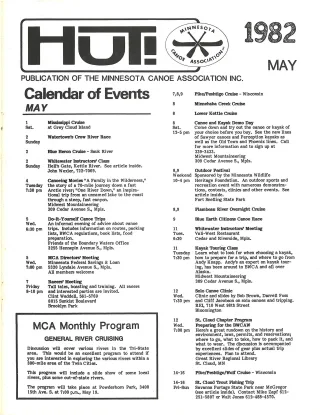
Magazine · 16 pages
May 1982 Magazine
Automatically captured text may contain recognition errors. Compare it with the original scan.
This shows the complete scan page, including any other material on it.
In Memory Of AUTHOR CALVIN RUTSTRUM DIES
Tw re) Great Environmentalists by Dave Logeais, Conservation Director
It is with great sadness that we report the passing of yet
another great outdoor writer and environmentalist.
Calvin Rutstrum died on February 5 in an Osceola,
Wisconsin nursing home. Rutstrom was 86.
WILDERNESS ADVOCATE DIES
Bill Magie, one of the founders of Friends of the
Wilderness, a group organized in 1948 to protect border
lakes country in northeastern Minnesota, died Maret 4 at Rutstrom was the author of 15 books. As compared to
his home in Solon Springs, Wisconsin. the writings of his friend, Sigurd Olson, who died January
13, Rutstrum's books were much more practical, "how-to"
Magie, 79, was born in Duluth and spent the bulk of his type manuals.
life in northern Minnesota and working to help protect
the Quetico-Superior country. He held a number of jobs, For many years Rutstrum had lived in Marine-on-St.
from mining and piloting to canoe guiding and surveying. Croix, Minnesota. He was born in Indiana but moved to
Minnesota as a boy. In between jobs as a cowboy in
Survivors include ‘his wife, Lucille, a son, four daughters, Montana, real estate and auto salesman, private
b
14 grandchildren, and one great-grandchild. Memorials detective and a hitch in the Marine Corps, Rutstrum
can be sent to the Wilderness Inquiry Foundation, Inc., traveled extensively in the wilderness regions of northern
111 Franklin Avenue East, Minneapolis, MN 55404. Minnesota and Canada.
With only seven years of formal education, Rutstrum
turned to writing. His books have sold over 700,000
copies and remain popular. They cover subjects ranging
from canoeing to log cabin building to winter camping.
island or hill is one or three miles away. And obviously
errors in judgement enlarge as distances increase. It's
very difficult to cross a 40-mile-long, island-studded lake
(and there are lots of 'em in Canada) and keep track of
your position without resorting to frequent time-distance
calculations.
All of which means you must carry a watch, preferably (o C Wi wa
one with a manual stop watch feature or digital read- mo ter
out. And you must know the approximate speed of your ti forYBEG
eanoe. We figure four miles per hour for loaded ps
wilderness cruising on calm water; three for trucking into
reasonable winds, two for bucking a big headwind.
Complex waterways are navigated "point to point" as I've
pointed out so you must keep accurate track of your AVOID
time. If. your "ETA" passes and you haven't hit your THE CRI INCH Qi
proposed attack point, then put ashore and check your : U
error. Likely you're very close to your objective. :
by Bill Micks
*The Fisher maps used in the BWCA don't have
declination diagrams—probably because the company (Taken from February 1982 Coastal CaNEWS)
thinks the information would only confuse canoeists. But
you must still apply the value if you want to be "right Avoid the Crunch
on". It's only about three degrees east, however, which ;
isn't very significant. Parallel sideslip is one of the best alternatives for
rock dodging.
AIMING OFF
Many paddlers when starting out use a stern rudder
Here's a simple procedure that will minimize the effects to get the canoe aimed either right or left of the
of small compass errors. Whenever possible, "aim off" rock that's just ahead, while the guy in the bow
slightly to make a small predictable error in a known paddles like crazy—the forward stroke with a lot of
direction. For example, if you want to go from F to the sweep on it. WRONG!
trail junction at J, and you compute the precise azimuth
to J (10 degrees) and you err slightly while following this Ql
course, you'll miss your objective and hit the trail to AE
either the west or south of J. In this instance, which way
(east or north) would you hike to find the trail junction?
Only a guess would provide the answer.
The current then sweeps the stern into the rock; thus,
If instead, you determine the azimuth to an imaginary they end broadside in a broach.
point (K) to the west of J, you'll have introduced a .
purposeful west "cone of error." You'll strike the trail iii <l [lc
somewhere to the west of J: Simply follow the trail east
to the trail junction.
TI
<tt>" ¢
Similarily, it's wise to aim off slightly when threading t M
your way among islands on a foggy lake. Thus you'd aim
to the center of an island rather that its very tip. As you The parallel sideslip will avoid such a mishap. 1) The
gain experience navigating, you'll decrease the size of bowman makes the decision to go right or left of the
your cone of error. rock. 2) He draws or pries and the stern counters
with the opposite stroke (a draw for the bow's pry or
Obviously I can't present a detailed course in navigation a pry for his draw) to move both ends of the canoe
in this small space. These are the basics though; they'll sideways in the same direction. The canoe will stay
get you through. And as with most things, practice parallel to the current and glide past the rock. The
makes perfect. Good luck...and good tripping! 13 same principles apply in solo paddling.
Generated issue overview: May 1982 issue of the Minnesota Canoe Association’s HUT!, containing canoeing and conservation articles, chapter news, instructional material, event features, and association information. Calendars, listings, advertisements, classifieds, membership entries, and forms are not treated as articles.
Generated summaries are descriptions, not original captured text. Page-range text shows complete scan pages and may include neighboring material.
Title transcribed from original publication
Generated summary: A river worker describes towboat size and operation and gives canoeists practical advice for staying safe around towboats, channels, and locks.
Open scan page 3Title transcribed from original publication
Generated summary: Explains the MCA’s membership drive, its point system, eligibility rules, and awards for members who recruit new members.
Open scan page 4Title transcribed from original publication
Generated summary: Reports on MCA board business, including programs, displays, events, cruises, and organizational plans discussed at the March meeting.
Open scan page 4Title transcribed from original publication
Generated summary: Provides information about obtaining U.S. Geological Survey topographic-map indexes, with different contact addresses for readers east and west of the Mississippi River.
Open scan page 4Title transcribed from original publication
Generated summary: Invites members to an outdoor festival at Fort Snelling State Park and describes its activities, schedule, cost, and opportunities for MCA volunteers.
Open scan page 5Title transcribed from original publication
Generated summary: Describes the MCA and Hoigaards’ two-day canoe event, including demonstrations, displays, mini-clinics, and a call for volunteers.
Open scan page 5Title transcribed from original publication
Generated summary: Encourages readers to join the St. Cloud Chapter at Savanna Portage State Park for an opening-weekend fishing and camping trip, with practical preparation and contact details.
Open scan page 5Title transcribed from original publication
Generated summary: Recounts MCA members’ indoor kayak and canoe rolling sessions, the students’ attempts to learn the Eskimo roll, and the group gathering afterward.
Open scan page 6Title transcribed from original publication
Generated summary: Reports on a St. Cloud Chapter meeting featuring a presentation about an Amazon trip, attendance, and upcoming chapter outings.
Open scan page 6Title transcribed from original publication
Generated summary: Explains the U.S. Supreme Court’s rejection of Minnesota’s challenge to federal authority over the Boundary Waters Canoe Area Wilderness, the decision’s consequences, and arguments surrounding the state’s appeal.
Open scan page 6AI-supplied descriptive title
Generated summary: Explains how to remove staples and glue from a strip-built canoe hull, shape and sand the wood, deal with small holes and dents, and prepare the hull for fiberglassing.
Open scan page 7Title transcribed from original publication
Generated summary: Outlines the 1982 point races for long-distance canoe racers, how points are awarded, and the competition divisions and eligibility criteria for traveling awards.
Open scan page 8Title transcribed from original publication
Generated summary: Shares Twin Ports Chapter news, including recent activities, plans for meetings and instruction, trip information, and requests for member participation.
Open scan page 10Title transcribed from original publication
Generated summary: Gives basic cautions for helping a hypothermia victim, including moving the person gently, removing wet clothing, and applying warmth in severe cases.
Open scan page 10Title transcribed from original publication
Generated summary: Introduces an MCA poling class for canoe travelers, explains its practical value and background, and asks interested readers to help with planning and instruction.
Open scan page 11Title transcribed from original publication
Generated summary: Provides enrollment information and a detailed outline of the Rapid Riders’ whitewater course, including instructors, session locations, equipment, and preparation advice.
Open scan page 11Title transcribed from original publication
Generated summary: Describes a short course on canoe-plan lofting and basic hull hydrodynamics, including its dates, location, fee, and contact information.
Open scan page 11Title transcribed from original publication
Generated summary: Reprints a brief report on a study estimating that acid rain had damaged thousands of lakes and tens of thousands of miles of streams in the eastern United States.
Open scan page 11Title transcribed from original publication
Generated summary: Explains how canoeists can plot bearings with an orienteering compass, account for magnetic declination, navigate between identifiable attack points, estimate travel time, and “aim off” to manage small errors.
Open scan page 12Title transcribed from original publication
Generated summary: Reports the death of Bill Magie, a founder of Friends of the Wilderness, and summarizes his life and work to protect the Quetico-Superior region.
Open scan page 13Title transcribed from original publication
Generated summary: An obituary describing Calvin Rutstrum’s life, writing career, books, and contributions to practical outdoor literature.
Open scan page 13Title transcribed from original publication
Generated summary: Explains how a canoe crew can use a parallel sideslip to avoid a rock, contrasting the maneuver with a stern-rudder approach that can lead to a broach.
Open scan page 13Title transcribed from original publication
Generated summary: Reviews a presentation about Midwestern whitewater canoeing, describing the equipment discussion and slide show of trips in Minnesota and Wisconsin.
Open scan page 15