← Back to The HUT

October 1981 · Volume/issue not printed or unknown

October 1981 Magazine

Issue first-page cover

Magazine · 12 pages

October 1981 Magazine

Captured text — scan page 10

Automatically captured text may contain recognition errors. Compare it with the original scan.

This shows the complete scan page, including any other material on it.

CLIFFS
CORNER

Why all this? By sandwiching the vulnerable plastic
sleeping bag liner between two abrasion resistant
nylon stuff sacks, we've eliminated any chance of
puncture—from inside or out. Contrary to popular
belief, holes in waterproof bags usually develop from
within a waterproof bag, not from without! For
example, every time you stuff your sleeping bag into a
plastic bag (if you do it that way), the zipper abrades
the plastic. In no time, leaks develop. But if you
first stuff the sleeping bag into a nylon sack, you

by Cliff Jacobson

Earlier this year, John Wexler. correctly suggested eliminate all sources of abrasion.
that I have difficulty writing short columns, : .
Presently I'm working on a new book (Canoeing the What about Duluth pack liners? Again, remember that
Wild Rivers of the Far North), which is taking all of abrasion and consequent holes usually develop from
my time. So I at first thought about dropping the within the pack. Whenever you stuff something inside
column, but figured if I kept it short, perhaps I could your pack-—your axe, saw, tennis shoes, etc.—you
still find time to share ideas with you. So here stretch and abrade the plastic pack liner. Again,
goes—the new format: holes!
I wonder how many of you have been brainwashed by The answer is to use an abrasion liner inside the pack
the anti-down media. You know, the Polarguard and (next to the pack contents) and to nest the ~
Hollofil commercials that suggest down is unsuitable waterproof plastic pack liner outside it. The inner
for canoeing. Usually goes like this: "If you capsize abrasion liner may be made of nylon or canvas, or
and get your down bag wet...you're in BIG trouble!" heavy (at least six mil) plastic. The six mil plastic
Yeah, I agree. But not because there's anything you get by the roll at lumber yards works fine. Just
wrong with your gear. It's your skills that need cut off what you need and tape up the edges with
improving. Frankly, if you're getting stuff wet on silver duct tape. You can use three or four mil thick
canoe trips, you'd best re-learn how to pack and plastic outside (next to the canvas pack) the abrasion
camp. What you need is not bombproof gear, it's liner if you prefer. Even a thin leaf and lawn size
bombproof skills—and these you can't buy at your local garbage bag will work if it's protected as I've
camp shop. suggested.
I'm not afraid to say I like down sleeping bags. I use In summary: Holes develope from within rather than
‘them on all my trips. And I've never gotten one wet. without! So pack your sleeping bag, clothes,
Ever! Read on... = whatever, first in a nylon abrasion liner. Then nest
i“ . this in plastic and follow suit with a second nylon
Some canoeing writers suggest you pack your sleeping liner. If you follow these suggestions, you'll never get
bag this way. First line your nylon stuff sack with a your down bag--or anything else—wet. And you won't
plastic bag, then stuff the sleeping back inside it. need to pay exorbitant prices for sophisticated
Seal the plastic liner with a heavy rubber band. This rubberized packs that develop leaks after a few
unit then goes into a Duluth pack that has been lined rigorous wilderness canoe trips.
with a large leaf and lawn size plastic bag. : a
Waterproof? Not hardly. And "not hardly for very Next month: Low-down on keeping the inside of your
long!" , tent dry in a rain.

Here's my way. First stuff the sleeping bag into its
nylon stuff sack (which need not be waterproof).
Then slide this unit into a waterproof plastic bag.

Seal the plastic bag with a loop of shock cord, then

slip the doubled combo into a second, larger nylon

stuff sack. The whole outfit then goes into a Duluth NO Ei

pack that has been lined with two six mil thick giant = ee ———

plastic bags. 101 - 78th Avenue North / Minneapolis, Minnesota 55444
‘ BOUNDARY WATERS CANOE AREA, MINNESOTA Nearly all routes can be arranged in loops so that you
won't have to backtrack. Portages between lakes are
by Robert MeQuilkin often steep and range from 20 feet to nine miles.
The Grand Portage Trail, the voyageurs' original and
(Taken from MARIAH/OUTSIDE, December '79/January only route into the interior, takes skiers onto Lake
'80) Superior.
The Boundary Waters is the largest single tract of Forest Service permits are required to enter the
land east of the Rockies reserved for cross country BWCA; camping at will and fires are allowed, but
skiing. More than 1,200 miles of hilly trails (canoe eans and bottles are forbidden. Along the Gunflint
portages in summer) link lakes and rivers. About 120 Trail, however, there are several lodges with wine
miles north of Duluth, the BWCA ean be entered huts or bars, if you need a break from strict winter
through Grand Marais or Ely. Outfitters, dogsleds, camping.
eabins, equipment rentals, and USGS maps are
available in both towns. (Grand Marais Chamber of A brief caution: Lakes on the edge of the BWCA,
Commerce, Grand Marais, MN 55640; Ely Chamber of including those bordering Ontario, are still open to
Commerce, Ely, MN 55731) snowmobiles. These include Crane, Little Vermilion,

Saganaga, Big Trout, Moose, Ensign, Knife, East
10 Bearskin, Alder, and Pine.

Articles (18) · Summaries (18)

Generated issue overview: October 1981 issue of HUT!, the Minnesota Canoe Association newsletter. The issue contains canoe-trip accounts, paddling and equipment articles, association and chapter reports, conservation news, and editorial material, alongside calendars, advertisements, classifieds, and membership information.

Generated summaries are descriptions, not original captured text. Page-range text shows complete scan pages and may include neighboring material.

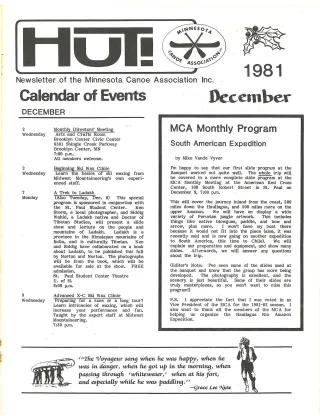
South American Expedition

Title transcribed from original publication

Generated summary: Mike Vande Vyver previews a presentation about the group's expedition in Peru, describing travel along the Huallaga and upper Amazon, trip preparations, equipment, and slides to be shown at an MCA program.

Open scan page 1

Read captured page 1 →

SCOUTING FOR NEW SITES

Title transcribed from original publication

Generated summary: A short piece recommends the 1981 Scouting Family Camping Directory as a way to find Boy Scout camps offering family camping, with information about availability, reservations, and facilities.

Open scan page 2

Read captured page 2 →

ANNUAL BANQUET

Title transcribed from original publication

Generated summary: Reports on the MCA annual banquet, including attendance, chapter reports, racing and cruising awards, and a presentation by members of the Peru expedition group.

Open scan page 3

Read captured page 3 →

TREASURER'S NOTE

Title transcribed from original publication

Generated summary: Explains that the MCA had to cover the cost of 13 banquet reservations for people who did not attend, and says future reservations will require payment.

Open scan page 3

Read captured page 3 →

NOVEMBER BOARD MEETING

Title transcribed from original publication

Generated summary: Reports on a joint meeting of the outgoing and incoming MCA boards, including discussion of finances, membership growth, dues, officers, publications, and educational programming.

Open scan page 3

Read captured page 3 →

A BACKWARDS GLANCE

Title transcribed from original publication

Generated summary: Mike Gilman recounts the MCA's work on the Paddler's Rendezvous '81 and explains the association's concern that a later Canoe magazine update omitted acknowledgment of its contribution.

Open scan page 4

Read captured page 4 →

MINNESOTA TRAILBOUND RECOMMENDATION

Title transcribed from original publication

Generated summary: George Skinner recommends Minnesota Trailbound outings, describing their affordability, winter activities, cabin access, and opportunities to try winter camping and equipment.

Open scan page 4

Read captured page 4 →

EDITOR'S NOTE

Title transcribed from original publication

Generated summary: The editor announces changes to the HUT! staff and planned MCA materials, invites reader submissions, and asks members to contribute equipment, cookery, and book reviews.

Open scan page 5

Read captured page 5 →

BEGINNING CANOEING

Title transcribed from original publication

Generated summary: A brief report describes an October canoeing class taught by Chris Berne at Lake of the Isles, including skill practice and an exercise in switching bow and stern positions, followed by a list of graduates.

Open scan page 5

Read captured page 5 →

SURVIVING THE WINTER

Title transcribed from original publication

Generated summary: A humorous article offers mock techniques for coping with winter canoeing cravings, from simulating wet feet and portages to deliberately imagining unpleasant paddling experiences; it concludes that spring is the real cure.

Open scan page 6

Read captured page 6 →

ONE WAY TO FIBERGLASS: A CANOE PADDLE

Title transcribed from original publication

Generated summary: Al Button describes reinforcing a canoe paddle blade with fiberglass cloth, epoxy resin, and roving, including preparation, layering, and working the resin to remove bubbles and creases.

Open scan page 7

Read captured page 7 →

ANOTHER WAY TO FIBERGLASS A PADDLE

Title transcribed from original publication

Generated summary: Karl Ketter gives an alternative method for fiberglassing a paddle, including repairing damage, applying cloth and resin to both sides, trimming the edges, and sanding the finish.

Open scan page 7

Read captured page 7 →

AI-supplied descriptive title: Twin Ports chapter year-end report

AI-supplied descriptive title

Generated summary: Chris Clay reviews the new Duluth-area chapter's first season, including whitewater and recreational outings, a local canoe race, boat building, officer elections, and plans for future activities and instruction.

Open scan page 8

Read captured page 8 →

CITIZEN VOLUNTEERS BOOST DNR PROGRAMS

Title transcribed from original publication

Generated summary: A short news item reports that nearly 10,000 unpaid citizen volunteers assisted Minnesota Department of Natural Resources programs in the year ending June 30, 1981, and notes the estimated value of their services and donations.

Open scan page 8

Read captured page 8 →

CRABS VS CONDORS

Title transcribed from original publication

Generated summary: A conservation news item discusses applying the idea of triage to endangered-species funding and the difficult choices involved in prioritizing species for protection.

Open scan page 8

Read captured page 8 →

A MERRY TIME ON THE LITTLEFORK - Part 5

Title transcribed from original publication

Generated summary: The author recounts navigating difficult Littlefork River rapids, including a close approach to a large rock and the group's run through Deadman's Rapids, followed by a hurried campsite, supper, and a comic nighttime scare. The account continues on page 11.

Open scan page 9

Read captured pages 9–11 →

CLIFFS CORNER

Title transcribed from original publication

Generated summary: Cliff Jacobson explains how to protect sleeping bags and other gear from water by layering abrasion-resistant liners with plastic, arguing that leaks often result from abrasion inside packs and bags.

Open scan page 10

Read captured page 10 →

BOUNDARY WATERS CANOE AREA, MINNESOTA

Title transcribed from original publication

Generated summary: A reprinted article describes cross-country skiing in the Boundary Waters, including access points, trails, outfitters, permits, winter camping rules, and a caution about lakes open to snowmobiles.

Open scan page 10

Read captured page 10 →