
WANTED!
Title transcribed from original publication
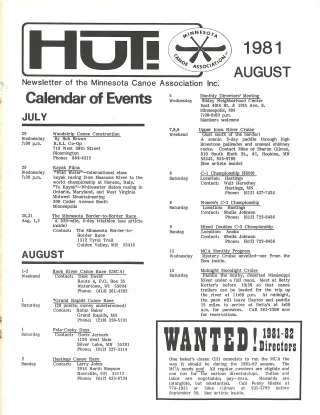
Generated summary: A humorous recruitment appeal describes MCA director roles and encourages members to nominate themselves or serve as representatives.
Open scan page 3August 1981 · Volume/issue not printed or unknown
Magazine · 16 pages
August 1981 Magazine
Automatically captured text may contain recognition errors. Compare it with the original scan.
THE
ZUMBRO
RIVER
Wabasha Co. <Zumbro River
[— i a
Dodge Co. Olmsted Co.
Limestone and sandstone bluffs watch over the Zumbro
River as it winds through southeastern Minnesota to
the Mississippi. The Zumbro flows through a deep,
narrow gorge hemmed in by rocky cliffs for much of
its length below the Rochester power dam (river mile
60). Below Theilman to the river's mouth, however,
the valley widens considerably and farmland stretches
away from the banks.
Woods and marshes: along the river offer a gentle
contrast to the striking bluffs. Trees in the river
valley are predominantly elm, box elder, willow, and
cottonwood, with some walnut.
The South Fork is the largest and most commonly
paddled branch of the Zumbro. Many canoeists start
their trip just north of Rochester. The campsite at
river mile 13 is several hundred yards from the river.
Canoeists expecting to drift down the Zumbro may be
taken by surprise. At even moderate levels, the river
has a liverly current, and travelers must keep a
lookout to avoid the many snags they're liable to
encounter. The Zumbro's. original name _ aptly
described this aspect of the river. The French called
it Riviere des Embarras, meaning river of difficulties.
The snags, caused by widespread bank erosion,
hindered the canoes of the French voyageurs engaged
in the fur trade.
Erosion has also obliterated a small waterfall which
was once located just above the town of Zumbro
Falls. At the site of the falls, the river now flows
rapidly over a sandstone rubble bed.
A stretch of mild rapids at Jarrett presents a rocky
obstacly course during low water.
The Zumbro is a good fishing river; anglers can take
eatfish, smallmouth bass, bullheads, and _ suckers.
Wildlife along the river includes deer, fox, and
grouse,
Usually a very shallow, muddy river, the Zumbro's
water level depends largely on the flow at the
Rochester power dam. The dam operators generally
release water on weekends, raising the level suf-
ficiently for canoeing.
The river's level may also rise dramatically, and
dangerously, after rainstorms, when flash floods are
likely to occur. There is generally a 4-hour lag
between the storm and the flood.
[ CONTINUING ADVENTURES
A MERRY TIME ON THE LITTLEFORK - Part 2
by Good Ol' Nels
Soon the yellow house comes in view, and it is even
nicer than it was in the fall. Pretty blue and white
trim and nice adjacent buildings and yard. There was
an island there, and I got a nice picture of Tom and
Doyle and the fine Scandinavian gentleman on his
dock. He introduced himself and we did likewise.
We had a valuable talk because he warned us of a
dangerous canoe-busting rapids just around the corner.
We had recently come through some pleasant rapids
and were pleased to handle those situations precisely
the way we wanted. None of us had canoed any
meaningful rapids the past year or so; we wanted to
be careful and conservative and sort of develop
slowly like the bunny hill in preparation for the big
slopes.
The elderly gentleman was quite concerned and
walked with us to the bend and urged us to consider
lining the canoes down. The first part was easy
enough, but as we walked through the woods to look
beyond, we quickly saw the trouble spot! Around the
‘bend and at the bottom of the swift run was a BIG
rock with a depression and plenty of souse water in
front of it and around. The water was extremely
fast and very shallow as it ran over flat rocks. The
screaming turn to the right was well guarded with
hull damaging rocks that offered no pleasant passage.
6
I have always believed that if you take good care of
the hull, it will take good care of you. Many a
terrifying cascade is quite pleasant to portage and to
photograph and avoid possibly wetting one's pants from
nervous fear. The odds with this mean sucker were
at the very best 60% to 40% in favor of the rock!
Indeed, probably much higher.
The senior gentleman was very relieved as we neatly
lined our way down. He admired our equipment and
would have been saddened at its demise. He told of
several nice canoes being reduced to wreckage there.
I complimented him on how nice his place was, and he
sincerely thanked me. He had been there over 50
years and started it off with a grub ax. Actually,
this rapid could be made by emptying the canoes and
accepting the hull abuse. Wide, strong, banjo paddles
would be needed, and many swift, strong, thrashing
strokes would be needed to fight that swift, shallow
water in its very intense capability to take you to the
"canoe eating rock."
Successfully clearing that area, with the nice fellow's
invitation to come back sometime for coffee and
pastries, we journeyed into mid-day. The conversation
was rich, and the music was better than ever. I
joined in occasionally with songs that I partly knew.
Around a bend, a Baltimore oriole flashed brightly off
to our right. Indeed, an oriole flying through a
woods is about the brightest thing I can imagine.
They are like a small flying bonfire. And just then, a
very large heron flew out the other direction. At
least two deer were seen this day, as well as mink
and woodechuck. The bow person would see all of the
Generated issue overview: August 1981 issue of HUT, the Minnesota Canoe Association newsletter. It contains canoeing articles, association and chapter news, race coverage, conservation information, and practical notices, alongside calendars, advertisements, member listings, classifieds, and association forms.
Generated summaries are descriptions, not original captured text. Page-range text shows complete scan pages and may include neighboring material.
Title transcribed from original publication
Generated summary: A humorous recruitment appeal describes MCA director roles and encourages members to nominate themselves or serve as representatives.
Open scan page 3Title transcribed from original publication
Generated summary: John Wexler invites readers on a Quebec canoe trip and describes the August mystery cruise on the Mississippi, including its route and arrangements.
Open scan page 3Title transcribed from original publication
Generated summary: A preview of a two-day Upper Iowa River trip describes the Kendallville campground, a 30-mile paddle, limestone bluffs, and take-out near Decorah.
Open scan page 3Title transcribed from original publication
Generated summary: The article discusses the shortage of riverside camping access and explains how Minnesota canoe routes are designated, funded, and developed with local support and DNR involvement.
Open scan page 4Title transcribed from original publication
Generated summary: John Kopp reports on Minnesota air-quality standards and the risk of acidification to northern lakes, and urges readers to write state officials and congressional representatives in support of stronger controls.
Open scan page 5Title transcribed from original publication
Generated summary: The vice president reviews MCA programs and asks members to suggest subjects, speakers, and outstate venues for the next year's program schedule.
Open scan page 5Title transcribed from original publication
Generated summary: A river profile describes the Zumbro's bluffs, branches, current, snags, fishing, water levels, and flash-flood risk.
Open scan page 6Title transcribed from original publication
Generated summary: A first-person trip narrative recounts navigating rapids, log jams, marsh bends, and wildlife on the Littlefork. Page 7 marks the continuation from page 6 and directs readers to page 15 for more.
Open scan page 6Title transcribed from original publication
Generated summary: St. Cloud chapter news includes officer information and reports on members, canoe construction, racing, and local activities.
Open scan page 7Title transcribed from original publication
Generated summary: Twin Ports chapter news reports on a racing canoe, local paddlers and trips, members' boats under construction, and a student caribou-tagging trip.
Open scan page 7Title transcribed from original publication
Generated summary: A preview of the August 2 Hastings C-1 race describes the proposed course and recounts the difficult weather and conditions at the previous year's inaugural event.
Open scan page 8Title transcribed from original publication
Generated summary: The racers' group asks members to propose topics for upcoming planning meetings and lists potential issues for the 1982 season, including race purses, championships, dues, and training.
Open scan page 8Title transcribed from original publication
Generated summary: A report on the July 5 Mississippi International Canoe Classic describes the course, conditions, safety problems caused by motorboats, and media attention. A separate results table follows the report.
Open scan page 9Title transcribed from original publication
Generated summary: A numbered list explains benefits of joining the long-distance racers, including access to racer networks, race information, training, and support for events and manuals.
Open scan page 10Title transcribed from original publication
Generated summary: The article explains how MCA membership supports a statewide canoeing association, representation for local and special-interest clubs, conservation work, racing, and publication of HUT.
Open scan page 10Title transcribed from original publication
Generated summary: A short advice section encourages racers to evaluate other teams' techniques, keep effort in perspective during a hard race, and train to sprint.
Open scan page 10Title transcribed from original publication
Generated summary: An expedition update describes preparations for a four-person journey in Peru, including waterproof storage, medical supplies, travel plans, food, and support arrangements.
Open scan page 11Title transcribed from original publication
Generated summary: A practice trip on the Namekagon River tests the expedition crew's gear, food, camp setup, and response to heavy rain and rising water before their Peru journey.
Open scan page 11Title transcribed from original publication
Generated summary: A report on a St. Croix River benefit cruise describes participants, paddling and camping conditions, and fundraising for clean air and water. The account continues on page 13.
Open scan page 11Title transcribed from original publication
Generated summary: A report on the MCA and Cascaders Club beginner whitewater class describes its sessions on the Mississippi, at Taylors Falls, and on the Kettle River, and thanks the instructors.
Open scan page 12Title transcribed from original publication
Generated summary: Cliff Jacobson presents a humorous exchange about canoe design for wilderness tripping, responding to a fictitious letter criticizing his earlier article.
Open scan page 13Title transcribed from original publication
Generated summary: A DNR notice gives the new Minnesota state park vehicle permit fees effective July 1, 1981, and explains how the revenue will support park maintenance and services.
Open scan page 14Title transcribed from original publication
Generated summary: A DNR advisory asks people to avoid disturbing nesting loons, explains threats from people and boats, and invites volunteers to report on nesting success.
Open scan page 14