Articles (21) · Summaries (21)
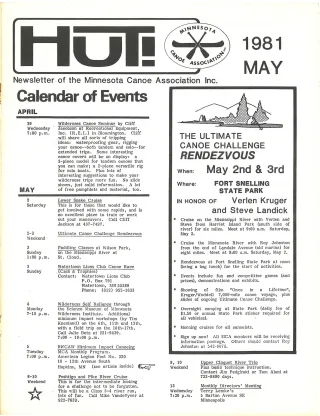
Generated issue overview: May 1981 issue of HUT!, the Minnesota Canoe Association newsletter. It contains an event calendar, association news and editorials, canoeing and camping articles, trip reports, racing material, a book review, advertisements, classifieds, and membership information.
Generated summaries are descriptions, not original captured text. Page-range text shows complete scan pages and may include neighboring material.
BWCAW Minimum Impact Canoeing
Title transcribed from original publication
Generated summary: Describes an MCA program on wilderness ethics and minimizing environmental impact in the Boundary Waters Canoe Area Wilderness, including trip planning, equipment, travel, camping, and waste.
Open scan page 3
Read captured page 3 →
From the Editor
Title transcribed from original publication
Generated summary: An editorial invites members to contribute articles and help produce HUT!, and announces planned features on wilderness canoe camping, canoe building, and camp cooking.
Open scan page 4
Read captured page 4 →
Boat Owners Told to Renew Licenses
Title transcribed from original publication
Generated summary: Reports that Minnesota boat owners whose licenses expired in 1980 should renew promptly to receive their licenses and decals before using their boats on public waters.
Open scan page 4
Read captured page 4 →
Cutback in State Funds Closes 13 Campgrounds
Title transcribed from original publication
Generated summary: Reports that 13 Minnesota state-operated campgrounds were scheduled to close because of a Department of Natural Resources funding cut, with possible further closures mentioned.
Open scan page 4
Read captured page 4 →
New! Twin Ports Chapter Forming
Title transcribed from original publication
Generated summary: Announces the formation of an MCA chapter in the Duluth area and gives a mailing address for correspondence.
Open scan page 4
Read captured page 4 →
The Ultimate Canoe Challenge
Title transcribed from original publication
Generated summary: Reports on Verlen Kruger and Steve Landick's long-distance canoe journey, recounting route milestones, record-setting paddling, coastal challenges, and their progress toward the Mississippi River.
Open scan page 5
Read captured page 5 →
MCA Beginner Open Canoe Whitewater Course
Title transcribed from original publication
Generated summary: Announces an open-canoe whitewater course with sessions at Hidden Falls, Taylors Falls, and Banning State Park, and describes equipment and participation requirements.
Open scan page 5
Read captured page 5 →
Builders Corner
Title transcribed from original publication
Generated summary: Recounts the author's respiratory and allergic problems while building canoes and offers safety advice on ventilation, protective equipment, and limiting exposure to building materials.
Open scan page 6
Read captured page 6 →
From Publications
Title transcribed from original publication
Generated summary: The publications director thanks contributors, comments on the newsletter's production and event coverage, requests feedback on monthly programs, and encourages members to support advertisers.
Open scan page 6
Read captured page 6 →
The Peshtigo River & Mike Vande Vyver
Title transcribed from original publication
Generated summary: A humorous first-person account of a Peshtigo River trip, describing challenging rapids, swims and mishaps, and the author's canoeing experiences with Mike Vande Vyver.
Open scan page 7
Read captured pages 7–10 →
From the Bow
Title transcribed from original publication
Generated summary: The MCA president discusses the Fort Snelling rendezvous, wilderness ethics, canoe design perspectives, upcoming race and instruction activities, and volunteer recognition.
Open scan page 8
Read captured page 8 →
Beginning Canoeing
Title transcribed from original publication
Generated summary: Describes a beginner canoeing course focused on turning, steering, and improving paddling strokes, and recommends it as preparation for the MCA whitewater course.
Open scan page 8
Read captured page 8 →
Springtime Confusion
Title transcribed from original publication
Generated summary: A comic account of early-season outings on icy Minnesota rivers, including logjams, beaver dams, mistaken car locations, a fall through ice, and other spring paddling mishaps.
Open scan page 9
Read captured page 9 →
Canoe and Boating Route Program To Take Back Seat To Public Access Program
Title transcribed from original publication
Generated summary: Criticizes a proposed DNR merger of the Canoe and Boating Route Program with the Public Access Program, arguing that it could prevent new river routes and weaken support for canoe travel facilities.
Open scan page 10
Read captured page 10 →
Cliff's Corner
Title transcribed from original publication
Generated summary: Discusses choosing canoe hulls for wilderness travel, weighing length, shape, load, comfort, tracking, covers, durability, and the risks of relying on equipment instead of sound judgment and skill.
Open scan page 11
Read captured pages 11–14 →
$5,000 Princeton Race
Title transcribed from original publication
Generated summary: Previews the 1981 canoe racing season's Princeton race on the Rum River, describing its prize distribution, approximate duration, finish location, and race information source.
Open scan page 12
Read captured page 12 →
Canoe Racers and Race Promotion
Title transcribed from original publication
Generated summary: Encourages racers to help promote canoe races by explaining the sport to sponsors and potential participants and by helping organize local events.
Open scan page 12
Read captured page 12 →
Minnesota Group Training
Title transcribed from original publication
Generated summary: Explains group training practices among Minnesota canoe racers, including pack workouts, rookie sessions, long slow distance runs, training vocabulary, and sample training formats.
Open scan page 12
Read captured pages 12–13 →
News, Rumors, Prevarications, Exaggerations...
Title transcribed from original publication
Generated summary: A racing-news column reports on canoe building, racers and race events, and changes in canoe lengths and specifications in USCA classes.
Open scan page 13
Read captured page 13 →
Shish Kebob in the BWCA
Title transcribed from original publication
Generated summary: Provides a wilderness-camp recipe for lamb shish kebob, including a home-prepared marinade, food storage and preparation directions, and cooking advice.
Open scan page 14
Read captured page 14 →
Does the Wet Suit You?
Title transcribed from original publication
Generated summary: Reviews Walt's book about kayaking, highlighting its humorous first-person writing, river stories, black-and-white photography, and appeal to boaters.
Open scan page 14
Read captured page 14 →