← Back to The HUT

March 1980 · Volume/issue not printed or unknown

March 1980 Magazine

Issue first-page cover

Magazine · 12 pages

March 1980 Magazine

Captured text — scan page 3

Automatically captured text may contain recognition errors. Compare it with the original scan.

This shows the complete scan page, including any other material on it.

BOUNDARY WATERS CANOE AREA
It's Political Survival

This is the last of the series concerning
the BWCA dispute.

by Barbara Ford

During hearings in the summer of 1977
in Minnesota on the two bills, there was
much shouting and finger pointing. Some
people claimed that making the BWCA a full
wilderness would deplete the local tax
base to.a critical. degree. Resort owners
said they would go bankrupt. Loggers said
they would not have enough softwood if they
were banned from the BWCA.

._ On the other side, a group was formed
called the Friends of the Boundary Waters
Wilderness. Its campaign includes a poster
with a spectacular photograph of ‘canoe
country and two lines of small, white type:
"The Boundary Water Wilderness--Take a
Long. Last Look Before It Vanishes."

The BWCA would vanish in a reletively few
years, too, if the land continued to be
abused. According to Superior National
Forest Studies, the thin, rocky soils of
the BWCA lands are the Forest's

least productive and the most sensitive. If
‘good forestry is practiced on the more fertile
and accessible lands nearer the pulp mills,
Minnesota can grow its present annual cut of
two million cords of forest products on fewer
than eight million acres--all outside of the
BWCA, according to Heinselman.

"The BWCA is not a good place to grow trees
for profit," William Nye, Minnesota Department
of Natural Resources chief, said.

The other issue that was under consideration was
the question of recreational use conflicts--
motorcraft versus paddle canoes and snowmobiles
versus cross-country skiers, Nye said. During
that time, federal law regulation activities

in the Canoe Area permitted the use of motor-
craft on more than 60 percent of the water
surface. Pressure was also heavy from snow-
mobiles in the congressional debates even though
there have been only about 7,000 snowmobiler
visits annually compared to 95,000 visits by
paddlers, hikers, skiers, and snowshoers iin the
BWCA, according to Heinselman.

"Sources of Congestion and Visitor Dissatisfac-
tion in the BWCA," by David Line, Forest
Service geographer, said 93 percent of the
paddlers found their experience impaired by
encounters with motorized vehicles. Minnesota
has 14,000. non-BWCA lakes on which motorboat ing
ig legal. Snowmobilers can legally operate on
those same 14,000 lakes when they are frozen

over, as well as on national and state forest
lands, in many state parks, and on thousands of
miles of state and private trails and along
road rights-of-way. ;

All of the heated debate finally resulted in a
compromise bill which was approved by the House
Sub-committee on Parks in April of 1978. The
proposal was introduced by Reps. Phillip Burton
of California and Burce Vento of Minnesota.

The compromise made a concession to both posi-
tions by allowing for more wilderness protection
yet it opened an additional 15 lakes to motor-
boat use and allowing two snowmobiling
corridors through the BWCA. The bill also con-
tained a provision to require the government to
buy the property of any resort owner who wants
to sell but would change their operations from
motorized recreation to wilderness canoeing,
hiking and the like,

That bill was eventually replaced by one from
Sen. Wendall Anderson of Minnesota. Anderson
had made it clear that he did not support a

bill sponsored by Fraser that would make the
BWCA free from logging, mining, motorboats and
snowmobiles.

But, it seemed as though there was more at stake
than just a wildernesss designation for the
Canoe Area. Rep. Fraser and Sen. Anderson were
both looking at a seat in the Senate. Election
results showed a definite north-south split among
Minnestoa voters, causing Fraser to lose by a
narrow margin. It seemed as though voters were
judging him by his strong pro-wilderness stand.

Anderson may have lost the election because
of his political goals and how he tried to
achieve them instead of his views on the
BWCA. His bill was too much of a compri-
mise, and a more acceptable one at that,

to hurt him politically. His ambitions
seemed to become more evident during one

of his fund-raising events in St. Paul.

John Denver, singer and active member of
environmentalist group, Friends of the

Earth, performed in the Twin Cities in

April of 1978 at a fund raiser for Anderson's
Senate election campaign. They have known
each other for two years, and their coopera-
tion was never noticed until two weeks

before that when Anderson: made public his
intentions for the BWCA. At least 160 of

the 17,000 ticketholders reportedly asked

for refunds in protest to Anderson's position.

Even though the issue of the BWCA Wilderness
was supposedly settled, a suit seeking invali-
dation of the 1978 BWCA legislation was filed
in U.S. District Court in Washington. In

July of 1979 the Citizens Committee on the
BWCA, composed of nine northeastern Minnesota
residents and eight from the rest of the state

Articles (14) · Summaries (14)

Generated issue overview: A Minnesota Canoe Association HUT newsletter issue containing canoeing and outdoor-recreation articles, association news, and organizational material. The OCR includes a reference to the March 1980 issue and a spring 1980 trip, but the issue date is not reliably legible.

Generated summaries are descriptions, not original captured text. Page-range text shows complete scan pages and may include neighboring material.

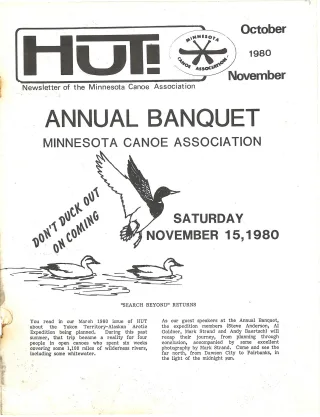
“Search Beyond” Returns

Title transcribed from original publication

Generated summary: A preview of the Yukon Territory–Alaskan Arctic expedition, in which four people traveled about 1,100 miles of wilderness rivers over six weeks. The expedition members are scheduled to recount the journey at the association banquet, with photography by Mark Strand.

Open scan page 1

Read captured page 1 →

Editor's Note

Title transcribed from original publication

Generated summary: The editor introduces a new newsletter format and co-editor Michelle Jerry, and invites readers to offer comments and suggestions and participate in the publication.

Open scan page 2

Read captured page 2 →

Boundary Waters Canoe Area: It’s Political Survival

Title transcribed from original publication

Generated summary: The concluding installment in a series about the BWCA dispute. It recounts debates over wilderness protection, logging, motorized recreation, legislation, and litigation, including a federal court ruling and plans to appeal.

Open scan page 3

Read captured pages 3–4 →

Just Paddling

Title transcribed from original publication

Generated summary: An invitation for association members to submit accounts of canoe-related outings, races, and trips, along with observations about water conditions, access, cleanup, hazards, and people encountered.

Open scan page 4

Read captured page 4 →

10th Annual Spring Trip

Title transcribed from original publication

Generated summary: An account of the April 19, 1980, spring canoe trip on Rice Creek. Seven canoes traveled the creek, encountering wildlife, garbage, an obstruction, and a capsize before reaching Locke Park and stopping for lunch in Fridley.

Open scan page 5

Read captured page 5 →

The Biggest Tree

Title transcribed from original publication

Generated summary: A brief report identifies a jack pine outside Lake Bronson State Park as the nation's largest, citing its circumference and height and noting confirmation by the American Forestry Association.

Open scan page 5

Read captured page 5 →

North Star Ski Touring Club…Still on the Right Track

Title transcribed from original publication

Generated summary: An introduction to ski touring and the North Star Ski Club, describing its growth since 1967 and the recreational opportunities it offers. The visible text mentions a monthly newsletter with ski updates, personal experiences, techniques, and other items.

Open scan page 5

Read captured page 5 →

Protect Minnesota’s Cougars

Title transcribed from original publication

Generated summary: A short appeal concerning a reported cougar sighting near Wawina and the lack of clear state-level protection for cougars. The author urges readers to contact legislators about closing a perceived gap in wildlife protection.

Open scan page 6

Read captured page 6 →

“Average” Winter Predicted

Title transcribed from original publication

Generated summary: A brief forecast roundup reports differing expectations for the coming winter, including an average winter prediction based on historical data and a forecast of 60 inches of snow with slightly below-average temperatures.

Open scan page 6

Read captured page 6 →

Are Canoeists Inadvertently Reducing Loon Populations?

Title transcribed from original publication

Generated summary: The article explains how loons leaving nests as canoes approach may reveal nest locations to ravens or crows, exposing eggs and chicks to predation. It notes concerns about loon populations in heavily used areas of the Boundary Waters.

Open scan page 6

Read captured page 6 →

Loon Observation Program Initiated

Title transcribed from original publication

Generated summary: A notice says the DNR is seeking volunteers to submit loon observations to help provide data on the bird’s population. It identifies the program as being conducted by the agency’s non-game wildlife office.

Open scan page 6

Read captured page 6 →

Design Concept Influences Minnesota Valley State Trail Construction

Title transcribed from original publication

Generated summary: A report describes design considerations for the planned Minnesota Valley State Trail, which is authorized to extend more than 70 miles from Fort Snelling to Le Sueur. It highlights the route's varied natural and historical features and its use of abandoned railroads and valley terrain.

Open scan page 7

Read captured page 7 →

Master Plan Studies of Mississippi River

Title transcribed from original publication

Generated summary: A report on cooperative master-plan studies of the Upper Mississippi River System, covering management, navigation, environmental issues, dredged-material disposal, and public participation. The stated purpose is to identify economic, recreational, and environmental objectives and needed authorities.

Open scan page 7

Read captured page 7 →

Outdoors Not Closed for the Physically Handicapped

Title transcribed from original publication

Generated summary: A brief report describes DNR measures intended to improve outdoor access for people with physical disabilities, including accessible facilities at state parks, an adapted trail, and special hunting permits.

Open scan page 7

Read captured page 7 →

Directory & index sections (2)

1979–80 Board of Directors, Minnesota Canoe Association, Inc.

Generated summary: A roster listing association officers, committee roles, chapter contacts, names, addresses, and telephone numbers.

Read complete scan page 11 →

Sponsor Listings

Generated summary: A section introducing businesses and individuals supporting the MCA through listings, with example sponsor entries and information about advertising in HUT.

Read complete scan page 11 →