
Get Rolled!!
Title transcribed from original publication
Generated summary: Announcement and description of Cascaders pool sessions teaching the Eskimo roll, with information about the course, registration, cost, and contacts.
Open scan page 3December 1976 · Volume/issue not printed or unknown
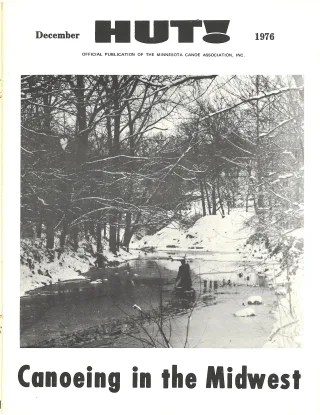
Magazine · 20 pages
December 1976 Magazine
Automatically captured text may contain recognition errors. Compare it with the original scan.
This shows the complete scan page, including any other material on it.
Review
By Lew Miller
Ultimate North Reflections
Our goal was a double one: to reach the Artic - and get From the North Country
back again - under our own power, by canoe; and to follow as
losel ld the route taken by Alexander Mackenzi i
ce ee ee ae by Sigurd F. Olson
voyage of discovery, also by canoe, in 1789.
This may be Siguard Olson’s last book. I hope not. But
Many of us dream of a long wilderness trip into the far the book has the tone of a man of many yearssaying “This is
North. A few actually accomplished that which they dream. what I believe, if I am remembered for nothing else, let it be
Ultimate North is a book for all of us. Robert Mead is a this.”
proficient canoer, a skilled observer of the environment, and . : .
what is most important an extremely able writer. And so his Reflections is a book quite unlike any that Sig has
book fits on my shelf beside those of Sigurd Olson. written before. Though anyone reading Listening Point or
Wilderness Days might predict that a book of meditative
In June 1974, the author and his son began their 1700 affirmations would be necessary for a man possessing such
mile trip. The refreshing thing about Mead is that he is extraordinary talent:
honest with his reader concerning the problems he faced, his
joys, disappointments, and fears. He admits a debt to and a It’s a book that is extremely hard to write about. For
respect for Sigurd Olson. But Olson often glossed over the what one reads seems so personal, honest, and open that to
difficulties of his trips. This is not true with Mead If you comment is to break trust with the confidences of a dear
could only read one book before canoeing the Mackenzie friend. More than anything else this is a book containing
River better make it Ultimate North. Mead is a more - man’s deep reflections, philosophy, and theology. A private
thorough historian too. thing shared.
e
The Canoer’s Bible I was lucky enough to get my copy autographed. The
words “Kindest Regards - Siguard F. Olson” combined with
what the book contains make it worth many times more than
For the time that you are on the water in your canoe, what I paid.
you depend on no one but yourself, your own combination of
strength, skill, experience. The canoe itself, slipping in LM
silken silence through the water is the intimate source of
that feeling of independence. Of all the vehicles human
inventiveness has evolved, no one is more perfectly adapted
to its physical medium.
I sought out this book after reading Ultimate North and
don’t regret for a moment its purchase. Robert Douglas
Mead is easy to read. And most of the time I agree with his
conclusions. To read two books by the same author in as
many weeks is to come to know him well.
Contained in the 164 pages of the book are nine chapters q\ >
including selection of equipment, handling the craft, where
to get help, places to go and some very helpful information in
the appendixes.
He has some good things to say about the MCA too.
A few of these local groups [notably the Minnesota
Canoe Association] are sufficiently strong and well Zz L- pf,
organized to rival the national one [American Canoe yf Yi)
Af
Association] in influence, activity, and general usefulness.
Mead’s chapter on choosing a canoe was quite well done.
He recognizes that different folks need different boats. I
think he stresses to heavily the tendency of wood-and-
canvas canoes to gain weight through water absorbtion of
interior wood. And he doesn’t seem to know about our fine
cedar strip canoes.
But I’m being picky. It’s a good book. I enjoyed it. It
may be hard to find (Daltons doesn’t stock it). Buy both : ;
books - they're well worth the price. Illustrations by Leslie Kouba
Page 11
Generated issue overview: A December 1976 issue of HUT, the official publication of the Minnesota Canoe Association. The issue includes canoe-building and sailing information, poling, wilderness-travel writing, book reviews, club news, and a fictional whitewater legend, alongside calendars, forms, advertisements, and other member material.
Generated summaries are descriptions, not original captured text. Page-range text shows complete scan pages and may include neighboring material.
Title transcribed from original publication
Generated summary: Announcement and description of Cascaders pool sessions teaching the Eskimo roll, with information about the course, registration, cost, and contacts.
Open scan page 3Title transcribed from original publication
Generated summary: A brief chapter-news column reporting Cascaders’ participation and results at the Last Ditch Slalom, MCA banquet news, and humorous member updates.
Open scan page 3Title transcribed from original publication
Generated summary: Report on the annual canoe builders contest, describing the turnout, winning woodstrip canoe, other placements, and entries in the solo canoe and North Canoe classes.
Open scan page 4Title transcribed from original publication
Generated summary: Practical guidance on outfitting a canoe for sailing, including rig types, mast and rudder placement, leeboards, sailcloth, spars, and options for obtaining a small sail rig.
Open scan page 5Title transcribed from original publication
Generated summary: Explains the MCA board’s decision to end its current resin and fiberglass-cloth sales arrangement, citing volunteer workload, material consistency, safety, and liability, and discussing possible alternatives.
Open scan page 6Title transcribed from original publication
Generated summary: A wilderness canoe-travel narrative about wind and waves in the Quetico area, recounting difficult crossings and arguing for judgment over adherence to a travel schedule.
Open scan page 9Title transcribed from original publication
Generated summary: Describes canoe poling as a way to travel shallow streams and reach less-used waterways, including in winter, and discusses the development and advantages of lightweight aluminum poles. The article continues on the following page with competition and technique history.
Open scan page 10Title transcribed from original publication
Generated summary: Book review of John McPhee’s account of Henri Vaillancourt building birch-bark canoes and a canoe trip in the Maine wilderness. The reviewer reflects on canoe craftsmanship and recommends the book for its descriptions of the craft and wilderness.
Open scan page 12Title transcribed from original publication
Generated summary: Review of Robert Mead’s account of a 1,700-mile canoe journey toward the Arctic, praising its candid treatment of travel difficulties and recommending it to readers considering the Mackenzie River.
Open scan page 13Title transcribed from original publication
Generated summary: Review of a canoeing guide that covers equipment, handling a canoe, finding help, places to go, and appendixes; the reviewer notes its advice and comments on its treatment of canoe choice and canoe organizations.
Open scan page 13Title transcribed from original publication
Generated summary: Review of Sigurd F. Olson’s book of personal reflections, describing it as an intimate work of philosophy and belief and emphasizing the reviewer’s personal response to it.
Open scan page 13Title transcribed from original publication
Generated summary: A comic fictional legend in which three Indigenous characters and a visitor run the Peshtigo River rapids; the story uses exaggerated misunderstandings to explain the characters’ later pale faces and the term “whitewater.”
Open scan page 14