
Get Rolled!!
Title transcribed from original publication
Generated summary: Announcement and description of Cascaders pool sessions teaching the Eskimo roll, with information about the course, registration, cost, and contacts.
Open scan page 3December 1976 · Volume/issue not printed or unknown
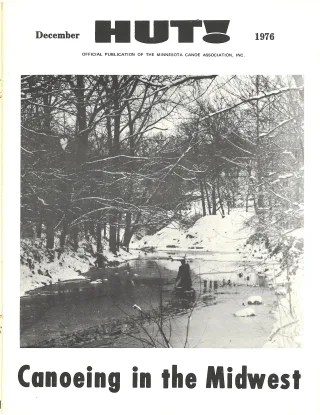
Magazine · 20 pages
December 1976 Magazine
Automatically captured text may contain recognition errors. Compare it with the original scan.
This shows the complete scan page, including any other material on it.
The sailing canoe
By Bob Brown
432-7557
The lee boards are normally mounted on the end of a
temporary thwart that is clamped to the gunnels of the boat.
This makes the boards easily removed. It also allows their
position to be adjusted, a real aid in trimming the boat.
I would like to discourage anyone not familiar with
sailmaking from trying to sew their own. My first two sails
were homemade cotton sails and both were very marginal.
The most common sail cloth used today is dacron. It is
nearly impervious to air and water, it stretches very little
and costs a few dollars. Plan on spending some money for
your sail, this is your motor so get a good one.
The spars can be made of wood, but I prefer aluminum
tubeing of a 6016 hardness. Again this costs some.
\— Rurdler
SJeeriag Arm
—Sfeering tines
leeboard Thwart
Any boat can be made to sail. A canoe does it quite well.
A canoe sailing rig can be built by anyone with a little
skill. A modest cost can add a new facet to your canoeing
experience.
The rig described here will not interfere with the
normal use of the canoe as most of it is removed when not in
use.
The two most common rigs used for canoes are the
lateen and sliding gunter rigs pictured. Both types are good.
The sliding gunter rig is the more efficient of the two .
On either rig I suggest that the mast step be secured
permanently at the forward thwart. The rudder hinge
should also be mounted permanently to the stern.
Anyone interested in building a sailing rig is invited to
join our new sailing chapter. Hopefully when we get this
group started we can combine our experience and come up
with some good sailors.
Anyone desiring to go it alone, I'd like to advise making
the lee boards of no less than %” lumber. Plywood doesn’t
make it. A section of 1X10 lumber with a little shaping
makes a fine set of boards. This same material is also
suitable for the rudder.
Sliding Gaiter Rig
ae
| Geez
T
At present there are several small sail boats on the
market that have a small lateen sail. A “Snark” is one of
them. The Snark has a sail just about the right size for the
beginning sailor.
One might find a dealer who will sell for a reasonable
price the spars, mast and sails for a Snark. You might also
find one of these boats badly busted up and be able to buy
the rigging from the former owner.
I have drawn a lateen rigged canoe and named the
parts. Basically this is what most sailing canoes look like.
Get busy. Spring is right around the corner. Building a
sailing rig will make the winter pass more quickly. I hope to
hear from anyone interested in sailing.
Page 3
Generated issue overview: A December 1976 issue of HUT, the official publication of the Minnesota Canoe Association. The issue includes canoe-building and sailing information, poling, wilderness-travel writing, book reviews, club news, and a fictional whitewater legend, alongside calendars, forms, advertisements, and other member material.
Generated summaries are descriptions, not original captured text. Page-range text shows complete scan pages and may include neighboring material.
Title transcribed from original publication
Generated summary: Announcement and description of Cascaders pool sessions teaching the Eskimo roll, with information about the course, registration, cost, and contacts.
Open scan page 3Title transcribed from original publication
Generated summary: A brief chapter-news column reporting Cascaders’ participation and results at the Last Ditch Slalom, MCA banquet news, and humorous member updates.
Open scan page 3Title transcribed from original publication
Generated summary: Report on the annual canoe builders contest, describing the turnout, winning woodstrip canoe, other placements, and entries in the solo canoe and North Canoe classes.
Open scan page 4Title transcribed from original publication
Generated summary: Practical guidance on outfitting a canoe for sailing, including rig types, mast and rudder placement, leeboards, sailcloth, spars, and options for obtaining a small sail rig.
Open scan page 5Title transcribed from original publication
Generated summary: Explains the MCA board’s decision to end its current resin and fiberglass-cloth sales arrangement, citing volunteer workload, material consistency, safety, and liability, and discussing possible alternatives.
Open scan page 6Title transcribed from original publication
Generated summary: A wilderness canoe-travel narrative about wind and waves in the Quetico area, recounting difficult crossings and arguing for judgment over adherence to a travel schedule.
Open scan page 9Title transcribed from original publication
Generated summary: Describes canoe poling as a way to travel shallow streams and reach less-used waterways, including in winter, and discusses the development and advantages of lightweight aluminum poles. The article continues on the following page with competition and technique history.
Open scan page 10Title transcribed from original publication
Generated summary: Book review of John McPhee’s account of Henri Vaillancourt building birch-bark canoes and a canoe trip in the Maine wilderness. The reviewer reflects on canoe craftsmanship and recommends the book for its descriptions of the craft and wilderness.
Open scan page 12Title transcribed from original publication
Generated summary: Review of Robert Mead’s account of a 1,700-mile canoe journey toward the Arctic, praising its candid treatment of travel difficulties and recommending it to readers considering the Mackenzie River.
Open scan page 13Title transcribed from original publication
Generated summary: Review of a canoeing guide that covers equipment, handling a canoe, finding help, places to go, and appendixes; the reviewer notes its advice and comments on its treatment of canoe choice and canoe organizations.
Open scan page 13Title transcribed from original publication
Generated summary: Review of Sigurd F. Olson’s book of personal reflections, describing it as an intimate work of philosophy and belief and emphasizing the reviewer’s personal response to it.
Open scan page 13Title transcribed from original publication
Generated summary: A comic fictional legend in which three Indigenous characters and a visitor run the Peshtigo River rapids; the story uses exaggerated misunderstandings to explain the characters’ later pale faces and the term “whitewater.”
Open scan page 14