← Back to The HUT

January 1973 · Volume/issue not printed or unknown

January 1973 Magazine

Issue first-page cover

Magazine · 20 pages

January 1973 Magazine

Captured text — scan page 6

Automatically captured text may contain recognition errors. Compare it with the original scan.

This shows the complete scan page, including any other material on it.

Canoeing The Vermilion River

by Sid Rommel

a
is ~ Sid Rommel has not only been active in
SS XK the MCA for a long time but also, and
CC probably for a longer time, been e and
The &s S around the Minnesota rivers. We plan to
_ Gorge - run this kind of article regularly and at the
“as ~ ey h be publish a collection
KD NS SSG Lake end of the year maybe pu ction.

203 S NSS

SSS Vermilion River in northern St. Louis
NS aa County is the outlet of Lake Vermilion.

203 N ie . It drops 239 feet in the 41% mile course

S to its mouth in Crane Lake. The river is

SSNS noteworthy for its variety; spectacular

Qs 24 falls, easily run to impossible rapids, rock

To N gorges to lake-like expanses, rice beds and
S > = . A <

Cusson SSS low hardwood flood plains to high pine
70 Chipmunk @ covered bluffs. All this is within easy
Miles Rapids = E reach because of numerous access points.
SX cho Trail Canoeing the Vermilion River used to

Ss be considered a tough trip, but now a

\ permanent camp may be established, or

W P
NS the family may stay at a nearby resort
SN rmitting canoeists to travel light with
1/4" = 1 Mile NS DeCaigny’s pe

53

4

SS :
Access BUYCK Dae Rapids only a day pack and to still have a taste of
* \ . wilderness. What used to be drudgery with

heavy camp equipment, now becomes joy.
Two hard days to four easy days should

SS
23 ‘ee ai be allowed for the whole trip or a shorter
“ee trip may be tailored to the time available.
\S Rapids Vermilion River, just below Vermilion
\ Dam (a concrete apron), has a drainage
To Orr e aie Fase area of 483 square miles and a mean flow
7 Miles aN = of 312 c.f.s. Because of the reservoir ca-
KS pacity of Lake Vermilion, the flow is more
&Xy constant than some of the other nearby
SA rivers, e.g., the Littlefork. There is always
aN enough water for satisfactory canoeing
N though the level of the water will influ-
SN ence the degree of hazard in approaching
S the portages around rapids and falls. In
Shively SN. Squaw Rapids high water, one must be especially careful
als a= 1 to approach close to the bank on the side
24 A ribbett’s > Lift oe on which the portage is located, with the
Landing S Vermilion Dam stern of the canoe held close to the bank
NS S so the current cannot grab it. In high
7 S <« water, some of the portages take off peril-
Vermilion Lake 2. S ously close to extremely swift water.
7 .. Many of the rapids can be run. But if
a that is your intention, all of them should
»_ be scouted from the banks first so that
you may determine if your skill is equal to
S the challenge.
If you start somewhere on Lake Ver-
24 milion, you should portage Vermilion Dam

Rapids on the right. While fishermen in
the lake have been inadvertently swept
over and have survived, others have
COOK drowned here. Or you may start from
Lloyd Tibbett’s private or fee access (just
south of county highway #24 and just
north of where the road turns off to Ver-
milion Lodge and Tibbett’s Resort, which
takes you to the west bank of the river
53 just below the Vermilion Dam Rapids.)

HUT! JANUARY 1973

Articles (10) · Summaries (10)

Generated issue overview: January 1973 issue of HUT!, the Minnesota Canoe Association magazine. It includes canoeing and river-trip articles, canoe-building guidance, a Minnesota geology feature, cross-country ski racing coverage, and the association’s position on the Boundary Waters Canoe Area. The issue also describes a new monthly MCA Newsletter and HUT!’s move to an every-other-month schedule.

Generated summaries are descriptions, not original captured text. Page-range text shows complete scan pages and may include neighboring material.

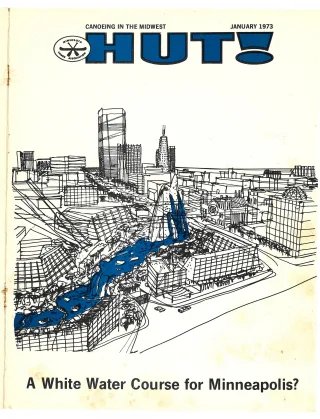
A Canoe Course For Minneapolis

Title transcribed from original publication

Generated summary: Proposes a whitewater canoe course in downtown Minneapolis, linking a suggested fountain project and riverfront redevelopment with opportunities for canoeists to design a course on the Saint Anthony Falls gradient.

Open scan page 4

Read captured page 4 →

Canoeing The Vermilion River

Title transcribed from original publication

Generated summary: Describes the Vermilion River route from Lake Vermilion to Crane Lake, including its rapids and falls, hazards, portages, campsites, access points, and historical and natural features.

Open scan page 6

Read captured pages 6–8 →

A Caution On MCA Resin

Title transcribed from original publication

Generated summary: Explains potential effects of exposure to canoe-building resin and styrene, and offers precautions for ventilation, skin and eye contact, clothing, and safe handling.

Open scan page 9

Read captured page 9 →

AWA Establishes Manmade Slalom Course Committee

Title transcribed from original publication

Generated summary: Reports the American Whitewater Affiliation’s appointment of A. R. McLain to chair a committee evaluating possible manmade slalom-course sites and working with local groups on course development.

Open scan page 9

Read captured page 9 →

The Story of Our Minnesota Earth

Title transcribed from original publication

Generated summary: Explains how glaciers and streams shaped Minnesota’s landscape, discussing lakes, moraines, eskers, Lake Agassiz, waterfalls, potholes, and ancient rocks, with examples from state parks.

Open scan page 10

Read captured pages 10–12 →

X-C Ski Racing For National Championships

Title transcribed from original publication

Generated summary: Previews the U.S. Ski Association Nordic National Championships at Hyland Lake Park Reserve in Bloomington, covering the event, course, racing and touring equipment, and ways spectators and recreational skiers can participate.

Open scan page 12

Read captured pages 12–13 →

Builders’ Contest

Title transcribed from original publication

Generated summary: A photo feature on the 1972 canoe builders’ contest, showing and captioning winning canoes and construction details. The printed credit identifies Ketter for the photographs.

Open scan page 14

Read captured pages 14–15 →

Kayaking the Grand Canyon

Title transcribed from original publication

Generated summary: Recounts a supported kayak trip down the Colorado River through the Grand Canyon, describing rapids, kayaking techniques and hazards, equipment, safety constraints, and the experience of the trip.

Open scan page 16

Read captured pages 16–17 →

Canoe Building and Weight Considerations

Title transcribed from original publication

Generated summary: Offers construction suggestions for reducing the weight of wood-strip canoes, including wood selection, strip thickness, fiberglass use, hull reinforcement, and lighter components.

Open scan page 17

Read captured page 17 →

MCA States Views on BWCA

Title transcribed from original publication

Generated summary: Presents the Minnesota Canoe Association’s recommendations for managing the Boundary Waters Canoe Area and Superior National Forest, addressing wilderness protection, logging, vegetation, minerals, water control, motorized use, and visitor access.

Open scan page 18

Read captured page 18 →