
FROM THE BOW
Title transcribed from original publication
Generated summary: The MCA president comments on summer fire precautions, the decision against military overflights over the Boundary Waters, and successful canoe events.
Open scan page 4July 1987 · Vol. 23 No. 7
Magazine · 40 pages
July 1987 Magazine (Vol. 23 No. 7)
Automatically captured text may contain recognition errors. Compare it with the original scan.
contour of your body. A _ sternum strap, with several attachment
points is standard, as is an easily removed padded hip belt.
A square of closed cell foam zips into the bag _ back for
additional carrying comfort. The entire unit is stitched and
reinforced like a parachute. Failure is impossible! The pack comes
in three sizes, from daypack small, to number 3 Duluth size--or as
much as you'll want to carry. I have the medium pack on hand, great
for solo boating, and for carrying pack and canoe together.
Though the unit is watertight when packed according to the
maker's directions, I advise use of plastic liners, "just in case."
About $130 from Grade VI, or get one from your favorite camping
store. These are yuppie style expedition grade packs, as beautiful
as they are practical.
COOKE FABRIC CANOE COVERS--There are those who can sew and those
who can't. After seeing one of Dan's renditions of my three-piece
cover, I figure I'm one who can't. Frankly, Cooke's three-piece
splash cover is the most beautiful and practical I've seen. He's
improved some on my design (see Canoeing Wild Rivers). Both skirts
feature the quick-release Velcro gusset with extra security snap.
And two inch wide Velcro is used generously wherever it is required.
Elasticised sections are “feathered" to drain water port and
starboard off the boat, rather than fore and aft as is the case with
most designs.
These canoe covers are simply impeccable. I have seen none
finer! I understand the Minnesota Outward Bound School has purchased
several and are quite pleased.
MAP CASE FROM COOKE CUSTOM SEWING--When I was a forward observer
with the field artillery in Germany (back around 1963), I had a
beautifully made map case which featured a full-length brass zipper,
vinyl front and fabric back. The giant case measured nearly three
feet square. It was the only case I'd seen that would accept a full
size topographic map without folding it.
Some time back, I asked Dan Cooke to make one up for me, and his
renditon was much nicer than the old army model I cherished. Now I
can slide full-length quads into the case, fold up the whole, and be
prepared for whatever lies ahead--this without constantly folding and
re-folding my map. Cost on these impeccable cases is $18.00, from
Cooke Custom Sewing.
THE E-M WANIGAN BOX, RE-BORN--The "old" E-M Wanigans which were
originally molded out of bullet tough Noral plastic, are now even
tougher in reinforced ABS plastic. The new ABS box is a few ounces
heavier than the old, but it’s a much stronger unit (the old one was
rhino tough!). Thicker padding in the shoulder straps, an even
better seal (this one can be “burped" like Tupperware, so you know it
keeps out water), $125.00. An optional padded hip belt ($22.50)
completes the package. From E.M. Wanigan.
THE NEW DULUTH TENT COMPANY--For those who aren't aware, Duluth
Tent and Awning Company is now under new management. And from the
look of their latest packs, things have gotten even better. My new
“custom grade" number three Duluth pack is constructed of 15 ounce
white canvas throughout with a double bottom of 20 ounce canvas. No
plastic pocket to pool water and get brittle and crack, All straps
are full grain tJeather and everything is double-riveted--an
improvement over some of the earlier models. The standard color is
olive. drab, of course, but you can specify “white” on special order
(an extra cost option). For wilderness canoeing, the venerable
Duluth packs remain tough to beat, especially in breathable,
water-shedding cotton canvas. For tripping in remote country where
you'll be making your own portages, the vivid white color has its own
reward. Of course, you can always paint a dab of yellow on an
olive-drab packsack, In #321 grade, these units are around $80 from
Duluth Tent, Inc.--Cliff Jacobson
July 1987-HUT! 19
Generated issue overview: July 1987 issue of HUT!, the monthly publication of the Minnesota Canoe Association. The issue contains association editorials, canoe trip reports, gear reviews, safety and building advice, chapter news, event information, advertisements, and membership materials.
Generated summaries are descriptions, not original captured text. Page-range text shows complete scan pages and may include neighboring material.
Title transcribed from original publication
Generated summary: The MCA president comments on summer fire precautions, the decision against military overflights over the Boundary Waters, and successful canoe events.
Open scan page 4Title transcribed from original publication
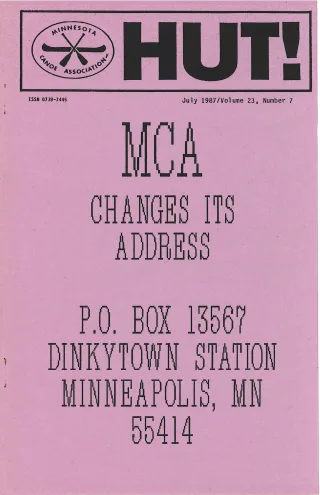
Generated summary: The editor explains the MCA's new post office box and recounts the North Country Weekend, including a Brule River paddle and an injury that ended the weekend early for his daughter.
Open scan page 5Title transcribed from original publication
Generated summary: A first-person account of the Twin Ports chapter gathering at Lake Nebagamon, describing camping, canoe trips, instruction, swimming, meals, and activities for families.
Open scan page 6Title transcribed from original publication
Generated summary: Bob Brown describes a two-day paddle from Eau Claire to Wabasha with Martin Van, noting the changing river landscape, wildlife, rain, and the option of staying at a friend's home rather than camping.
Open scan page 12Title transcribed from original publication
Generated summary: James Robinson criticizes the naming of Wenonah's 16-foot-6-inch Echo as a Sundowner, contrasting it with the 18-foot Sundowner and discussing the shorter canoe's appropriate uses.
Open scan page 13Title transcribed from original publication
Generated summary: A notice describes a newly published guide and map for the 75-mile Border Route Trail, including its route, landscape, history, availability, and contact information.
Open scan page 14Title transcribed from original publication
Generated summary: Norm Kagan recounts solo canoe journeys on the St. Francis, Ross, Blackstone, and Peel rivers in the Yukon, including wildlife, challenging rapids, hazardous sweepers, weather, and his take-out at Fort McPherson.
Open scan page 16Title transcribed from original publication
Generated summary: A product review column evaluates a Grey Owl Scout paddle, Silva compass, Blue Puma hat, Grade VI canoe packs, Cooke canoe covers and map case, an E-M Wanigan box, and Duluth packs.
Open scan page 18Title transcribed from original publication
Generated summary: A report on the 25th Jensen Handicap describes the race conditions, Gene Jensen's connection to the inaugural winning team, the post-race gathering and video, and gives a historical list of winners.
Open scan page 24Title transcribed from original publication
Generated summary: Bob Brown compares polyester resin and West System epoxy for canoe construction, considering total building costs, strength, weight, abrasion resistance, durability, and his own experience.
Open scan page 32Title transcribed from original publication
Generated summary: After recounting a capsize in which his canoe drifted away, Steve Heimer considers the risks of separation from a boat and asks readers to suggest a safer solution than tethering themselves to it.
Open scan page 34Title transcribed from original publication
Generated summary: Bob Brown reports on participation in an urban canoeing series at Lake of the Isles and invites readers to contact him if they want the series offered again.
Open scan page 34Title transcribed from original publication
Generated summary: The authors recount a weekend paddle on the Kettle and St. Croix rivers, including shallow rapids, walking canoes through a rocky stretch, camping, a pig roast, dancing, and a Sunday paddle.
Open scan page 35