
FISHHEAD STEW
Title transcribed from original publication
Generated summary: A camp-cooking recipe for fish stew, with instructions for preparing a broth from fish parts and cooking it with rice and onion soup mix.
Open scan page 2November 1970 · Volume/issue not printed or unknown
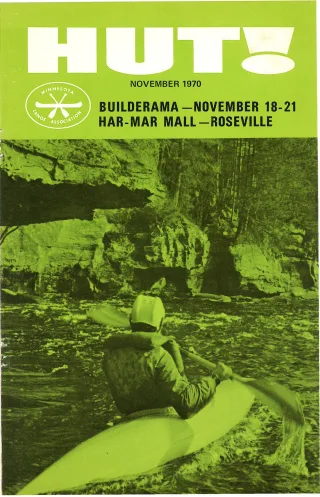
Magazine · 12 pages
November 1970 Magazine
Automatically captured text may contain recognition errors. Compare it with the original scan.
This shows the complete scan page, including any other material on it.
Canoe Rambling
In the northern part of the Superior National Forest, there is
an incredibly hard to believe canoe country. That is the way it was
described to me 45 years ago. It's anaccumulation of land and water
at different elevations, creating rivers, waterfalls, and rapids.
It's a galaxy of water and rock, and is covered with a dense forest
of pines, all 1,034,852 acres of it.
If you think there is a scarcity of roads, you should have tried
it 45 years ago. As space does not permit telling of all the roads,
I will tell you of one--the one we call the Gunflint Trail.
At that time I had the most commonof all cars, the Model T Ford.
(At that time who had money?) By taking the body off the Model T,
we had a runabout with 28 horsepower possible, 35 to 40 miles per
hour at full throttle, 30 by 3 inch tires, 70 pounds of pressure
per tire. By bending a few pipes and drilling a few holes in the
right places, we could use the canoe as a top. Around my seat I
piled packsacks, extra gas, oil, and other gear used for paddling
and camping. At thattime there was atrail (not much, but a trail).
It grew during prohibition when it was used as a trail for run-
ning whiskey, so I have been told. It was narrow, hilly, and full
of ruts. About all I could do was get as far as Poplar Lake where
I started my first .canoe trip all by my lonesome, as my buddy took
sick and was unable to make it.
At that particular time of my life I was endeavoring to be a
land surveyor, so I had become accustomed to measuring everything
by walking, say forty steps per one hundred feet, plus visual ob-
servation. I figured this whole trip, quite a few miles on water--
give or takeafew yards on portages, to be 46 miles of paddling and
just over five miles of portaging. If you were alone and had to
make two trips on each portage, then that would triple the miles on
the portages. The route went from Poplar Lake to Winchell, Brule,
Temperance, Cherokee, Long Island, Omega, and back to Poplar Lake,
an easy, beautiful one-week trip.
If you leave home on a Friday evening and start canoeing Satur-
day morning fromSeagull Lake toAlpin, Red Rock, Saganaga (pronounced
sag'-na'gaw), and back toSeagull Lake, you will be back home Sunday.
You will have gone 23 miles by water. On this one, your wife could
portage that old log you sometimes call your canoe over the only
half mile portage.
Another old favorite of mine is from Sawbill to Cherokee, Long
Island, Snipe, Copper, Tuscarora, (that tonguetwister) Gabimichi-
gami, Little Saganaga, Polly, Alton Lakes, and back to Sawbill Lake,
62 miles of paddling with two miles of portaging.
Walter B. Jones
22 HUT! — NOVEMBER 1970
Generated issue overview: November 1970 issue of HUT!, the Minnesota Canoe Association publication. The OCR contains canoe-racing profiles, trip writing, an event report, association news, recipes, and a poem. Several pages are blank, fragmented, or appear out of printed-page order.
Generated summaries are descriptions, not original captured text. Page-range text shows complete scan pages and may include neighboring material.
Title transcribed from original publication
Generated summary: A camp-cooking recipe for fish stew, with instructions for preparing a broth from fish parts and cooking it with rice and onion soup mix.
Open scan page 2Title transcribed from original publication
Generated summary: A camp recipe for loaf-shaped biscuits, with instructions for mixing the dry ingredients and baking or steaming the dough in a skillet.
Open scan page 2Title transcribed from original publication
Generated summary: Profiles of canoe-racing teams in the Quebec races, describing their results, equipment, racing histories, and performances in the Classic. The OCR identifies Barb Ketter as the photographer, not as the article author.
Open scan page 3Title transcribed from original publication
Generated summary: A reminiscence about early canoe travel in the Superior National Forest, including descriptions of the Gunflint Trail and several routes with estimated paddling and portaging distances.
Open scan page 4Title transcribed from original publication
Generated summary: A report on the Minnesota Canoe Association's October 4 St. Croix cruise, attended by 70 members in 30 canoes, with a description of the weather, canoe variety, and gathering at O'Brien State Park.
Open scan page 5Title transcribed from original publication
Generated summary: A humorous account of a gathering to name Charlie's homemade cast-iron canoe, which is presented as a cooler and party centerpiece. The OCR cuts off during the naming suggestions.
Open scan page 7Title transcribed from original publication
Generated summary: Introduces the Minnesota Canoe Association's newly elected officers and directors, describing their experience, interests, and priorities for the coming year.
Open scan page 10Title transcribed from original publication
Generated summary: A short poem celebrating whitewater kayaking, racing, and the desire for an affordable kayak.
Open scan page 11